YRITTÄJÄ, tule mukaan omiesi pariin! Liity Yrittäjiin.
Our action on behalf of business owners in 2025
A strong year of advocacy – next Finland needs growth
In 2025, our advocacy work focused on implementation of the Government Programme. The government aims to put public finances on a sounder footing and reform Finland’s labour market. A number of measures have already been enacted, including the long-standing objective of Suomen Yrittäjät of removing bans on local bargaining. The proposal concerning dismissal on personal grounds was adopted by Parliament shortly before Christmas.
Finland now needs growth. Taxation of work and entrepreneurship must be reduced, competition increased and markets opened up. Labour market reforms must continue, the construction sector needs renewed momentum and access to finance must be secured. At the same time, competition between banks must be strengthened and compliance with payment terms regulation monitored. Public administration must be streamlined and business activity left to businesses. Regulation must be lightened and the use of natural resources enabled.
We work to ensure that the conditions for entrepreneurship improve across the country and that taxation is not tightened. We make sure that the operating conditions of all companies are taken into account – from solo entrepreneurs to employer entrepreneurs, regardless of company size or legal form.
We advocate for business owners at the local, regional, national and European level. At every level, decisions are made that affect how it is possible to run a business in Finland. The more of us there are, the stronger the voice of business owners.
Strong EU lobbying in Brussels
With the new Commission beginning its term, Suomen Yrittäjät, the Finnish SME association, has actively influenced initiatives affecting enterprise. We participated in SMEunited working groups and met officials and decision-makers in EU institutions on issues important to business owners. Petri Salminen, Chair of Suomen Yrittäjät, served as Chair of SMEunited. The importance of enterprise and SMEs to Europe’s competitiveness was highlighted in high-level meetings with key EU actors.
Simplifying EU regulation and avoiding additional national obligations
At least half of the regulation affecting businesses is based on EU legislation, and we are concerned about its continued growth. We actively influenced the Commission’s regulatory simplification packages and emphasized that no new national obligations should be layered on top of EU rules.
In line with our objectives, the government committed to conducting a “Finland add-on” review of obligations beyond existing legislation. The new Commission has also promised to reduce the regulatory burden on SMEs by 35%.
Permit processes and investment to gain momentum
Several billion euros’ worth of investments in Finland are on hold partly because land-use planning and permit processes are slow or decisions have been appealed to administrative courts. In line with our objectives, the government committed to shortening and streamlining permit and zoning decisions and to curbing unnecessary appeals.
The government circulated for comment a proposal on planning as a new Land Use Act, which includes objectives that matter to us (the right to submit a zoning initiative, partnership zoning, smoother planning processes and narrowing the right of appeal). The proposal will be brought to Parliament in early 2026. One-stop-shop permit processes were also developed and permit streamlined more broadly to accelerate investment.
We highlighted business owners’ financing challenges
For SMEs, access to finance is a major barrier to growth. We kept the issue on the agenda with decision-makers, banks and the media. We appealed to banks to bear their social responsibility in financing companies. We also researched the topic and business owners’ views so that financing challenges and their impacts would be better understood.
We improved micro-enterprises’ access to growth finance
Obtaining bank financing has become significantly harder for micro-enterprises and solo entrepreneurs. We succeeded in getting Finnvera to launch a fixed-term financing pilot for the growth of micro-enterprises. Studies linked to the micro-enterprise loan pilot that ended in March 2025 showed that micro-enterprises face difficulties obtaining bank financing for growth measures.
In our view, the financing gap in the market is justified to address through a public financier going forward as well. On this basis, Finnvera decided to launch new fixed-term financing for growth projects of micro-enterprises. Applications open in February and loans can be applied for until the end of July 2026.
We invested in the Business Owner’s Financial Help cooperation network
Corporate bankruptcies have risen to their highest level since the recession of the 1990s. To support business owners, a broad expert network has been established, involving representatives of ministries, business life, the financial sector, the tax administration, accounting firms, Mieli ry and the Business Owner’s Financial Help advisory service. A representative of Suomen Yrittäjät chairs the network’s advisory board, and we have actively participated in events and promoted expansion of the network. The aim is to strengthen SMEs’ finances early, to avoid unnecessary bankruptcies.
We influenced long payment terms between companies
Large companies have recently extended their payment terms, causing significant financial harm to SMEs operating as contractual partners. Long payment terms strain micro-enterprises and solo entrepreneurs in particular, who often lack the financial buffer to wait unreasonable periods for payments. Legislation requires that, in B2B contracts, payment terms must not exceed 30 days unless the parties explicitly agree otherwise. In practice, almost 60% of SMEs report that this precondition for agreement is not met.
In spring, the Market Court issued a significant decision finding that a large company had breached payment terms legislation. We met senior management of large companies and demanded compliance with payment terms rules. The Finnish government also heard us and, in its September budget session, decided that long payment terms would be curbed by examining the establishment of a supervisory authority.
Sole traders’ position improves in the positive credit register
Lenders generally check an applicant’s existing income and credit using the positive credit register introduced in 2024. However, the register does not always show, for example, earned business income, dividend income or rental income. The situation of sole traders has been particularly untenable, as their income data is not visible in the register. This has led to unreasonable situations and credit refusals for business owners.
Over the year, we actively met political decision-makers, supervisory authorities, the financial sector, representatives of the Ministry of Justice and the Tax Administration as the register controller to resolve the issue. At our request, the Ministry of Justice began investigating the position of sole traders. We also sought an opinion from the Data Protection Ombudsman, who issued a public interpretation favourable to business owners. In September, the Finnish government stated that the position of sole traders would be fixed.
We influenced reform of business owners’ pensions (YEL)
We encouraged the responsible minister to appoint a rapporteur to examine reform of the Entrepreneur’s Pension Act, and the rapporteur’s report was published in December 2025. We strongly influenced the process so business owners’ broad distrust and criticism of the system would be heard and taken into account. Suomen Yrittäjät did not accept the rapporteur’s report as such, among other reasons because an additional €140 million bill for 60,000 people running small businesses would lead many to stop operating.
We have influenced the process so that the minimum threshold for mandatory insurance is raised and business owners are given more freedom to determine their level of social security. Lowering the threshold would sharply increase pension contributions for many sole and small-scale business owners. In December 2025, the minister launched a “business owner dialogue”, in which Suomen Yrittäjät is actively involved. Preparation of the reform continues in 2026.
We published a construction-sector repair package
In November 2025, Suomen Yrittäjät published five solutions for Prime Minister Orpo’s government and municipalities to accelerate the construction sector quickly and in a controlled way. Construction is a key part of the national economy and has significant employment impacts nationwide. We proposed, for example, halving transfer tax for a fixed period, increasing the household expense deduction to accelerate renovations, and a state guarantee for financing construction projects.
We proposed reform of the Occupational Healthcare Act
Suomen Yrittäjät proposed reforming the Occupational Healthcare Act to better meet the needs of SMEs, lower the threshold for hiring and open new opportunities for small social and health business owners. A development programme for occupational health was published.
We influenced the introduction of a business restraining order in Finland
Retail in particular has suffered from repeated incidents of antisocial behaviour in shops. The situation has been untenable, and we have lobbied for the drafting of legislation in the ministry to introduce a business restraining order in Finland. The government proposal will be submitted in spring 2026.
We helped scam victims
Almost half of business owners recognize that they have been the target of scams or attempted scams. We helped business owners affected by fraud daily and advised them on how to act. We also trained business owners to identify fraud and carried out active advocacy to prevent fraud that makes business activity more difficult.
We supported companies in the waste management sector
In recent years, small waste-transport companies have struggled to compete with larger companies and municipally owned companies. Orpo’s government committed, in line with our objectives, to ensuring that SMEs can also operate in the market. We are involved in legislative projects at the Ministry of the Environment aimed at improving circular economy markets and competitive neutrality of private waste management companies in relation to municipal in-house companies. We also helped business owners with questions relating to tendering for waste transport contracts.
SMEs are considered in consumer protection
EU consumer-protection measures adopted in 2023–2024, relating to consumer influence in the green transition, the right to repair, product liability and consumer credit, have been implemented in national legislation. We influenced the national implementation so that no obligations beyond EU rules were added and SMEs’ position was considered.
The EU has also issued proposals strengthening consumer protection in the travel sector, especially for package travel and multimodal journeys. We strongly influenced Finland’s positions and, with SMEunited, directly at EU level, to ensure SMEs’ position and capacity to meet requirements are considered and that obligations remain reasonable.
In the proposal for a directive on alternative dispute resolution for consumer disputes, we influenced the process so that Finland’s functioning system, such as the Consumer Disputes Board, was not put at risk; we prevented extension of competence to non-contractual factors and ensured that traders were not given unreasonable response obligations.
Curbing “Temuing”
We influenced Finland and the EU to quickly seek and implement effective national and EU-level solutions to the problems caused by low-cost imports from third countries via e-commerce, to safeguard the competitiveness of Finnish SMEs. Minister Marttinen appointed a working group to examine solutions to problems linked to low-cost imports and e-commerce.
Reduced administrative burden from data protection obligations
The European Commission proposed easing controller obligations under the General Data Protection Regulation (GDPR). Together with SMEunited, we influenced the process so that disclosure obligations and administrative burden for SMEs in particular are reduced.
Work on Finland’s standardization strategy advances
Orpo’s government promised to draw up a national standardization strategy defining national priorities and strengthening the role of standardization in supporting companies’ competitiveness. We accelerated the start of the work. Preparation began with a preliminary study, and we influenced the process to involve Suomen Yrittäjät.
Better access to justice in small civil disputes
The aim of the procedure for small civil disputes is to improve access to justice in eviction and tenancy disputes by developing a simplified court procedure with a lower cost-risk. We lobbied to extend the procedure in future to other small disputes as well.
SME readiness guide strengthens crisis readiness
We improved SMEs’ ability to prepare for exceptional and crisis situations by preparing and publishing a comprehensive SME Readiness Guide in Finnish, Swedish and English.
SMEs’ position in national crisis readiness
We influenced preparation of legislation strengthening readiness for exceptional circumstances (such as the Communicable Diseases Act, health protection legislation, the Emergency Powers Act and legislation safeguarding security of supply) so that the outcome is clear, understandable and fair, and takes SMEs’ needs and roles into account.
Easing corporate responsibility regulation
With SMEunited, we influenced the process of easing the administrative burden of EU corporate responsibility regulation so that the impacts on SMEs are considered. In addition to scope thresholds, we focused attention on indirect impacts and spillover effects, where obligations imposed on large companies are transferred along supply chains to smaller companies. EU corporate responsibility rules were amended in the direction we demanded to reduce the administrative burden for SMEs.
Effective advisory services from the competition authority
Companies cannot obtain an advance binding view from the competition authority that planned activities comply with competition rules. The authority nonetheless provides advisory services in competition law matters. We influenced the process so that competition advisory services are as effective as possible and awareness of the advisory option increases.
RDI funding considers SMEs
A large share of the RDI funding decided during this government term is directed to companies and to cooperation between research organizations and companies. This aligns with our objectives: investing in companies produces the greatest leverage effects. With our input, SMEs have their own targeted three-year RDI funding programme from 2026. The competitively allocated funding is a three-year pilot.
Clarifying and streamlining digital regulation
We influenced the national implementation of EU digital legislation (such as the Data Act and the AI Act) to make it clearer and more flexible. For SMEs, being able to access a one-stop shop of digital authority services is essential. Through our EU organization SMEunited, EU digital legislation is also being lightened, made more flexible and simplified. In Finland, Traficom was selected as the lead authority, and it will also assume advisory and monitoring responsibilities.
Bans on local bargaining removed
Opportunities for local bargaining increased in all companies complying with collective agreements, and our long-standing demand to remove bans on local bargaining was realized on 1 Jan. 2025. Previously, the bans prevented companies that are not members of employer unions and that apply generally binding collective agreements from agreeing locally on matters permitted by the agreement.
With the new legislation, the bans were removed. In addition, company-level collective agreements can be used to agree the same flexibilities that were previously agreed via national agreements. The legislation did not impose a requirement for a shop steward; bargaining is also possible with a trust representative elected by the personnel.
The threshold for applying the Cooperation Act raised
We influenced amendment of the Cooperation Act in line with the Government Programme to ensure it mainly applies to companies employing at least 50 employees. In addition, minimum time periods for change negotiations were halved. The legislative amendments entered into force on 1 Jul. 2025.
We ensured business owners’ perspectives were heard in labour law drafting
In 2025, several labour law projects based on the Government Programme were drafted. We worked to ensure that the voice of business owners was heard. In 2025, legislation was drafted relating to leave-savings, consolidation of limitation periods linked to working time, and implementation of employee representation. We lobbied to prevent weakening of the employer’s position.
Drafting continues in 2026, including on easing fixed-term contracts, shortening notice periods for lay-offs, and removing the re-employment obligation in companies with under 50 employees.
We lowered the dismissal threshold
We strongly influenced the easing of dismissal on personal grounds to meaningfully lower the threshold for dismissal and reduce the hiring threshold.
We resisted additional employment regulation
We worked closely in EU projects to ensure that unnecessary additional regulation is not created in Finland and that EU-level labour market negotiations do not advance matters harmful to employers. We prevented national regulation on psychosocial load that would have introduced significant new obligations for employers.
We influenced regulation of platform work
In 2025, we participated in preparation of implementation of the Platform Work Directive. We ensured in particular that the boundary of an employment relationship does not change and that platform work can still genuinely be carried out as a business owner. The work continues.
Deregulation continued
We proposed new deregulatory measures to the government. In the midterm review, Orpo’s government wanted to secure resources to ensure fast permit processes and continuation of a priority procedure. Unfounded appeals were reduced by increasing fees for unfounded appeals to administrative courts or the Supreme Administrative Court. In addition, the government decided to carry out a deregulation pilot in employment services in pilot areas.
We defended SMEs in legislation on essential work during strikes
We highlighted the perspectives of small employers in legislative preparation on ensuring essential work during industrial action. We promoted solutions enabling regulation to be implemented realistically in small companies as well. We influenced the legislation to allow emergency work under the Working Hours Act to be used to protect life and health during industrial action.
Efficient and fair climate action
We want our emissions reduction actions to be as effective as possible, while at the same time benefiting the national economy and companies’ competitiveness. In our climate policy programme, we presented solutions supporting the slowing of climate change and biodiversity loss in an economically and socially sustainable way. The programme sets out how both emissions reductions and economic growth can be advanced from a business owner perspective.
We influenced the process to channel proceeds from the EU’s new ETS2 emissions trading system via the Social Climate Fund to micro-enterprises. This strengthens the smallest companies’ ability to invest, for example in equipment, and improves equality in relation to larger actors. In line with our objectives, the government also advanced smoother permit processes to accelerate climate and circular economy investments.
We helped thousands of business owners through our advisory service
The Suomen Yrittäjät legal advice service is a valued member benefit and a significant reason to join the business owners’ organization. To secure positive development and improve customer experience, we improved the service over the year based on feedback.
For example, a tailored advisory service for solo entrepreneurs provided assistance with everyday challenges again this year. During 2025, the advisory service was contacted around 30,000 times, and the NPS for feedback collected from users was 80/100 in 2025.
Business owners’ taxes must not rise
Finland’s growth and success depend on companies and their owners, the people who do business and create jobs. Considering entrepreneurial risk in the taxation of companies and business owners is therefore important. We consider it important that a stable business environment for enterprise and investment is secured with incentivizing, predictable taxation. Suomen Yrittäjät has lobbied strongly to prevent further tax rises for business owners and companies.
Income tax decreasing
Suomen Yrittäjät lobbied to ensure income tax is reduced at all income levels and the highest marginal tax rates are lowered from around 59% to around 52%. We maintain that at least half of income earned from work should always remain in the individual’s pocket.
Corporation tax decreasing
Suomen Yrittäjät proposed lowering the corporation tax rate by two percentage points. In the 2025 spending limits decision, the government decided to lower the corporation tax rate from the current 20% to 18% from 2027.
Flat-rate home office deduction remains for micro-enterprises and solo entrepreneurs
Suomen Yrittäjät influenced the process to retain the flat-rate home office deduction for sole traders, which is particularly important for micro-enterprises and solo entrepreneurs. From 2026 onwards, the flat-rate home office deduction can no longer be claimed against wage income. Employees are automatically granted an income-acquisition deduction, which sole traders do not receive on the basis of business income.
Transitional period for the tax-free bicycle benefit
In the 2025 spending limits decision, the government decided to remove the tax-free bicycle benefit from the beginning of 2026 for bicycle benefits where the employer and employee committed to the arrangement on or after 24 Apr. 2025. Suomen Yrittäjät lobbied for a transitional period for bicycle benefits agreed before that date.
We influenced regulation on share exchanges
In the 2025 spending limits decision, the government decided to prevent minimization of dividend taxation by using share exchange arrangements. Suomen Yrittäjät demanded that a share exchange must not lead to a less favourable position in dividend taxation than a situation where no share exchange is carried out. In further drafting, the proposal was amended: valuation is not based on the previously proposed acquisition cost prior to the share exchange, but on the mathematical value prior to the share exchange.
Employer-paid work-related legal costs for employees made tax-exempt
We demanded that legal advice and court costs paid by an employer on behalf of an employee in a criminal matter must not become taxable income for the employee if the act or omission occurred as part of work duties. Following the legislative amendment entering into force at the beginning of 2026, an employer can cover legal advice for an employee tax-free not only in criminal matters but also in civil disputes and administrative proceedings.
Suomen Yrittäjät principles advanced in transport taxation
We promoted development of transport funding and taxation from the perspective of companies. With other business organizations, we supported drafting of the reform. Work on transport taxation reform began in late 2024, and we continue to influence its drafting in line with positions prepared in the organizations.
We demanded distribution infrastructure to support the fuel transition
We influenced several projects to advance the transition in transport power sources. Predictability and analysis of overall impacts are important for companies. We emphasized development of distribution infrastructure for alternative power sources, especially for heavy transport needs to allow companies to invest in fleets with confidence in the development of distribution infrastructure.
We published an urban policy programme
As urbanization accelerates, the role of cities as operating environments for enterprise grows. As an organization, we are taking a stronger role in the conditions for enterprise in cities.
To support advocacy, an urban policy programme was drafted and published for cities. Over the autumn, the programme was rolled out in several cities, and the rollout continues next year. In connection with publication, we also published the 10 key Suomen Yrittäjät actions for vibrant cities.
We were active in the Team Finland reform
The Team Finland reform is progressing, with the Business Finland’s export promotion staff transferring to the Ministry for Foreign Affairs from the beginning of 2026. For the transition phase, a new Team Finland management group was established in spring 2025, which also includes representation from Suomen Yrittäjät.
The Team Finland strategy was completed in September and Business Finland’s strategy in November. Suomen Yrittäjät is concerned that Business Finland’s innovation policy tools are being terminated or suspended (Market Explorer, Exhibition Explorer and Young Innovative Companies). At the same time, the amount of RDI funding is increasing.
Suomen Yrittäjät is also concerned about the state of domestic export promotion. The Ministry for Foreign Affairs focuses on export promotion support in target countries, and Business Finland is focusing its activities more on specific sectors and target companies.
Suomen Yrittäjät proposed that the range of services of the vitality centres established from the beginning of 2026 should include more services related to growth, commercialization and exports than the previous ELY Centres offered.
We planned establishment of the Team Finland Export Academy
The largest bottleneck in export promotion is fragmentation of services. The idea of the Export Academy is to compile information on export training on one platform and coordinate training more purposefully to allow companies access to exactly the competence they need. The platform will also provide advance notice of planned export promotion trips to allow companies to prepare through training.
A working group was assembled within Suomen Yrittäjät to establish the academy, and the idea has been communicated to Business Finland, the Ministry for Foreign Affairs, Finnvera, senior ELY directors and other business organizations. We have also been in contact with ministers from different parties. Support for establishing the platform appears strong, and in October a funding application for the project was sent to the Yksinyrittäjäin Säätiö.
We conducted an export survey – over 1,000 respondents
More than 1,000 member companies employing at least four people responded to the export survey in spring and summer 2025. According to the results, 39% engage in direct exports and 26% in indirect exports, while 25% plan to start exporting. The most interesting export destinations are other Nordic countries and EU countries (75% of respondents). Of respondents, 69% are interested in increasing exports, and more than half of them want to participate in export promotion trips and export training.
Companies’ interests were communicated to embassies in the destination countries, and further action was discussed with the Ministry for Foreign Affairs, Business Finland and the ELY Centres.
Reform of the Public Procurement Act moved to the final stage
Reform of the Public Procurement Act drafted by the government progressed during the year, and the government is expected to submit its proposal in January 2026. From the perspective of business, the reform appears positive. The government aims to achieve significant savings in public service provision in order to safeguard high-quality services. On the business side, there is confidence that the objective can be achieved.
Several research results emerged during the year indicating that public service provision is significantly less efficient than private service provision. Efficiency differences range from two per cent to 68%. Studies show that benefits can be up to fivefold compared with municipalities’ additional costs.
The reform has been criticized on the grounds that in future it will not be possible to find service providers in smaller municipalities. This is not correct. The Finnish Competition and Consumer Authority asked 488 companies about the issue in its own study just under a year ago. Around 80% of companies were prepared to expand operations if markets opened up. Similar results have also been obtained through the Yrittäjägallup survey.
We are pleased that some in-house companies have already announced that they will enter markets for fair competition. We will gain more fair competition, which is a source of new creativity. We are increasing procurement expertise by preparing a training package for public procurers.
We offered public procurement counselling for businesses
We continued procurement counselling services financed by the Ministry of Economic Affairs and Employment for business owners and contracting entities. Advisory services have been offered across Finland in all regions covered by our regional organizations. This has been a concrete service for business owners who needed support in responding to calls for tender. Our public procurement counselling helped guide procuring entities build procurements to include SMEs.
We provided SMEs with information about public procurements and encouraged them to take part in competitive tenders. Promoting dialogue between contracting entities and tenderers has also been key. The service has been necessary and valued by business owners.
Employment areas important to business owners were established
Employment services transferred to municipalities from the beginning of 2025. We were concerned that an in-house market similar to that in wellbeing services counties would emerge in employment services. Some employment areas informed us that they want to pilot a business owner-led employment area in which market dialogue is carried out and services are tendered to also allow private service providers to participate in competition. One proposal that has gained publicity is “employment Tinder”.
We influenced reform of central government’s regional administration
Central government’s regional administration is being reformed on 1 January 2026, when the vibrancy centres and the Finnish Supervisory Agency will be created. We strongly stressed that the new vibrancy centres must find a complementary cooperative role in relation to municipalities’ business services, development companies, employment areas and business organizations.
Companies need a clear, company-driven service path from their home region to the world. Instead of individual tools and services, the aim should be to develop regional business service ecosystems that can respond to companies’ needs in different situations.
We expect the Finnish Supervisory Agency to ensure that decisions affecting companies and business owners are made quickly and predictably in the future to prevent business activity from facing unnecessary delays due to slow bureaucracy.
We influenced Eastern and Northern Finland programmes and establishment of special economic zones
We influenced programmes for Eastern and Northern Finland. In our statements, we wanted to strengthen regions’ existing competitive advantages. For example, Kymenlaakso has logistics, South Karelia a hydrogen economy, South Savo water expertise, North Savo health technology, Oulu 6G expertise, Lapland tourism expertise, North Karelia photonics and Kainuu metal-industry derivatives.
We prepared our own industrial policy programme
Alongside the government’s industrial policy strategy, we published our own industrial policy programme. The programme was delivered to political decision-makers and civil servants during spring 2025, and its themes were also published in the media.
We criticized the Ministry of Economic Affairs and Employment strategy as state-led and emphasized stronger development of companies’ operating environment. In the government’s midterm review, a new funding mechanism for vibrancy centres was proposed: €30 million intended to accelerate research and development in small and medium-sized enterprises.
Suomen Yrittäjät Vibrancy Barometer 2025
The Suomen Yrittäjät Vibrancy Barometer surveys Finnish business owners’ views of the vibrancy of their own region. The survey is carried out every other year alternating with the Municipal Barometer. In 2025, the Vitality Barometer was conducted for the second time. A total of 4,073 business owners responded. The barometer serves as an excellent tool for business policy.
We campaigned actively in municipal and regional elections
The theme of our municipal and regional elections campaign was “dissenter”, highlighting business owners’ ability to think differently. In the municipal elections, business owners accounted for 23% of all councillors elected (2,160 business owners), matching the share in the 2021 elections. In the regional elections, the share of business owner councillors fell from 20% to 16% (217 business owners).
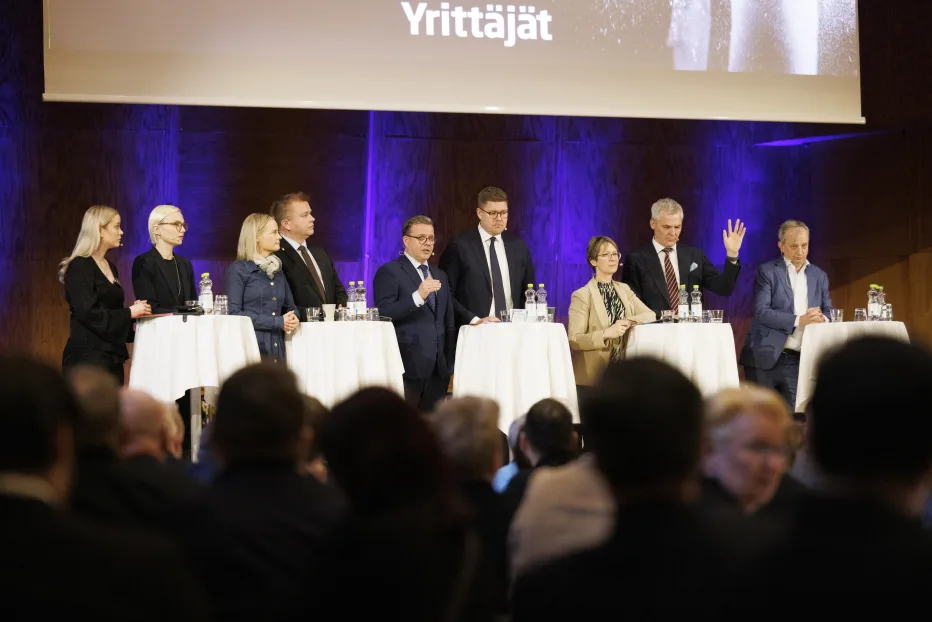
We supported and helped candidates with a business-owner background in campaigning. We kept election themes important to business owners visible in the media. In February 2025, we organized a municipal and regional elections debate for the chairs of parliamentary parties, which received wide attention in national media, including television news.
The municipal elections programme emphasized municipalities’ business owner-friendliness, attractiveness as living and cultural environments (work follows people), tolerance and openness, a business-friendly approach, business services, and fair and open competition.
The regional elections programme emphasized putting wellbeing services counties’ finances on a sounder footing, cooperation with companies, a multi-provider model, introduction of voucher models, and fair procurement.
Dedicated operation created for municipal advocacy
After the elections, many councillors with a business owner background are involved in municipal and regional decision-making. The central organization prepared a municipal advocacy plan defining objectives and division of work between local societies, regional associations and the national association. At the same time, a municipal tour was launched to support local organizations in special challenges and to spread successful examples to other municipalities.
Municipal advocacy is progressing as planned: assessment of business impacts has been elevated as a priority; materials are being produced for local societies; and we participate in municipal leadership seminars across Finland. In addition, “No. 1 Enterprise Municipality” training sessions are delivered according to municipalities’ wishes, with emphasis on business impact assessment and Municipal Barometer results.
Fifth course underway in Municipal Leaders’ Business Owner Academy
The second module of the Municipal Leader’s Business Owner Academy was held in January 2025 and the third, the Brussels module, in April. Eleven municipal leaders participated. The next course began in November 2025, with 13 municipal leaders participating. Next spring’s Brussels trip is under preparation. The Municipal Leader’s Business owners Academy is an important part of our municipal advocacy.
We are strengthening our profile in wellbeing service counties
We are developing our advocacy work towards wellbeing service counties in a systematic and goal-oriented way. The key focus is ensuring that small companies can participate in providing their expertise and services to wellbeing service counties. Building an effective organization-wide cooperation model is a prerequisite for successful advocacy.
A temporary solution was found for problems in the Soteri register
In early 2025, as many as 4,000 social and health companies were unable to operate because registration queues were so long and it was unlawful to operate without registration.
Thanks to strong advocacy, a temporary act relating to the Soteri register entered into force on 1 Feb. 2025. Under the act, independent social and health professionals and comparable service providers could begin operations immediately after submitting an application for Soteri registration. This has particularly improved the ability of small social and health professionals and solo entrepreneurs to begin work.
We influenced progress of the unit cost project in social and healthcare
A project relating to unit cost calculation in social and healthcare was established at the Ministry of Finance. Over the year, we lobbied to allow the cost calculation model to make the prices of public and private actors to be comparable.
Unfortunately, the reform is progressing slowly. At present, it is possible to provide averages for only a few service packages. New service categories will be published as the calculation model is completed. True change, however, requires comparison of costs at unit level.
Enterprise education strengthened throughout education path
We reinforced the significance of enterprise education at all educational levels, from kindergarten to university. In March, with the Enterprise Education Forum, we organized a seminar in the Pikkuparlamentti building, with parliamentary parties and stakeholders participating actively. We influenced the updating of enterprise education and financial literacy policies, as a result of which the Ministry of Education and Culture established a working group in which Suomen Yrittäjät participates.
We promoted preparation of an enterprise upper secondary diploma, launched at the Finnish National Agency for Education, and participated in development of enterprise-related qualification units in vocational education with Agency experts.
Youth interest in enterprise increasing
The Youth Future Report 2025 shows that interest in enterprise has increased. Of lower and upper secondary students, 51% could in future operate as business owners; 45% would continue a business founded by someone else; and 27% intend to establish their own business. Of young people, 68% consider business activity important for Finland and 40% would like to see schools providing more enterprise education. Long-term advocacy is visible in the results.
We offer valuable benefits to our members
We offer our members valuable member benefits which we constantly develop. The most popular benefit is our free legal counselling.
We offered information based on surveys
We carried out several surveys focusing on the impacts of new Government Programme measures, the economic cycle and availability of skilled labour. These were monitored regularly through the Yrittäjägallup survey. The SME Barometer mapped companies’ outlooks, research and development activity, and use of digitalization and AI.
We also participated in research examining the role of immigrants in Finnish business and economic activity. A study by PTT examined immigrants as employees and business owners across sectors and the companies of immigrant business owners. We were one of the funders of the study.
The Vibrancy Barometer 2025 surveyed business owners’ views of the vibrancy of their own region. Results were published on a separate site enabling comparison across regions and questions.
We highlighted financing challenges in business transfers
We strengthened the operation of the national Business Transfer Forum in cooperation with its 25 member organizations and highlighted needs to develop companies’ financing situation. We examined the current state of regional business transfer services and created concepts for regional forums, supporting cooperation and service development.
We submitted multiple statements emphasizing the importance of business transfers for business continuity and economic vibrancy. We also strengthened digital visibility by adding content to yrittajat.fi and ov-foorumi.fi.
We built business transfer competence, knowledge and solutions
We published a new business transfer policy programme and presented it to influencers both in Parliament and in the regions. The Yrittäjägallup survey showed that business transfers are timely for up to 40,000 companies, and the topic received wide media coverage. In the culture and creative sectors project, we supported business fitness development and business transfers for sole and micro-enterprises by organizing webinars and training. We also strengthened awareness of acquisitions as a tool for internationalization and provided practical tools, events and information.
Funding for the Restartup business incubator
We secured funding for the Restartup business incubator project, aiming to create a new type of incubator in Finland to support post-acquisition growth and internationalization.
Business Transfer Week reached widely
The nationwide Business Transfer Week, held for the fourth time, included 21 events across Finland and reached around 1,000 business owners and experts. The highlight, the Business Transfer Conference, brought together financiers, experts and stakeholders to discuss corporate finance and promoting business transfers. A members of Parliament panel also strengthened decision-makers’ awareness of the importance of business transfers for vibrancy.
Cultural business owners highlighted in the Vitality & Culture discussion tour
During the year, we organized four culture discussions: in Hämeenlinna, Mikkeli, Lapua and Pori. The events discussed the role of cultural business owners in municipalities, the future of culture at local level, and the importance of cultural business owners for tourism.
The aim was to strengthen understanding of the role of culture and creative sector business owners in regional vibrancy ahead of the municipal elections and to promote their operating conditions. A significant share of them are solo entrepreneurs. The discussions were carried out with the Finnish Cultural Foundation.
Eloon! tour strengthened cooperation between culture and business life
We continued cooperation with the Arts Promotion Centre Finland’s Luova verkko project and brought the Eloon! tour to Kuopio and Joensuu in autumn 2025. With local actors, we sought creative solutions for developing cultural tourism, the experience economy, the city centre and the circular economy. The best ideas generated in workshops were rewarded with incentive funding. The tour was carried out in cooperation with municipalities, ELY Centres, regional councils and our regional organizations. The Eloon! tour strengthened the role of culture and creative sectors as partners for business life and highlighted new ways to build regional vibrancy, involving solo entrepreneurs in particular.
Strong impact with sectoral organizations
We cooperated with our 56 sectoral organizations. In 2025, we influenced sector-specific issues strongly together. Open exchange of information and close cooperation increased the efficiency of advocacy and strengthened its visibility.
MPs’ enterprise group continued active work
The enterprise group founded in 2022 includes around 80 MPs. We bring entrepreneurial expertise, messages and needs to the group. In 2025, meetings were organized as usual.
Our communications help entrepreneurs keep up to date
The Suomen Yrittäjät newsletter in English goes out to our members every month. It tells our member business owners about current legislative amendments, new and tips to improve their business.
Our member business owners keep well-informed about other changes affecting their businesses by following Suomen Yrittäjät channels: Yrittäjät.fi news, the Yrittäjä app, the Yrittäjä podcast, the Yrittäjä member magazine, newsletters and social media channels. In addition, members can order the Yrittäjä Plus magazine.
Subscribe to Yrittäjä Plus here >>
Advocacy training for business owners
The Suomen Yrittäjät advocacy concept is comprised of training modules for member business owners who want to influence or already influence at the local, regional or national level. The goals of the training are to network participating business owners from around Finland, strengthen their skills in advocacy, communications and organizational work, as well as ensure as an association that we have capable position of trust holders influencing issues important to business owners.
Mentor programme supports young entrepreneurs
We organized a mentoring programme for young business owners in cooperation with the Boardman competence network. The programme is intended for business owners under 36 who need help, support or encouragement in developing their business. Mentoring was provided by experienced people in the Boardman network. The programme has been run since 2017, with around 30 young business owners participating each year.
Developing business owners’ competence
Our core mission is to develop business owners’ competence and competitiveness. This is delivered through high-quality events and training. Key tools for competence development include the National Entrepreneur Days, the Municipal Leadership Seminar, webinars and online courses. In 2025, we also launched the Business owners & AI learning packages in cooperation with Elisa.
Digital learning solutions
The Business owners Academy online course offering grew to 20 courses. The offering of paid webinars was reduced slightly. Cooperation with Elisa on use of AI attracted good numbers. The most attractive content areas were sales, marketing and AI. Training was offered both for solo entrepreneurs and employer business owners.
We brought together around 20,000 business owners
The National Entrepreneur Days attracted 1,700 business owners and delegates interested in entrepreneurship to Tampere. The event was particularly praised for its excellent seminar programme and the opportunities for networking with fellow business owners.
One of Finland’s largest municipal, regional and business influencer events, the Municipal Leadership Seminar, was held in Kuopio in May. The event was attended by around 1,100 delegates from around Finland. In total, around 20,000 business owners and societal influencers met through events and training offered by Suomen Yrittäjät.
We brought the Suomen Yrittäjät stage to SuomiAreena
We brought the Suomen Yrittäjät stage to Finland’s largest discussion festival, SuomiAreena in Pori. During the day, the stage featured numerous speeches and discussions on enterprise and vibrancy. At the event, we proposed removing public holidays as part of funding defence expenditure, and the proposal received very wide media attention.
We celebrated the 10th anniversary of Business Unplugged
We organized the English-language Business Unplugged event aimed at immigrants on 12 Nov. in Helsinki. The event turned 10 and its theme was “Sell Smart, Market Smarter”. The event attracted over 140 participants to network, develop business competence and make use of free business and legal advice.