YRITTÄJÄ, tule mukaan omiesi pariin! Liity Yrittäjiin.
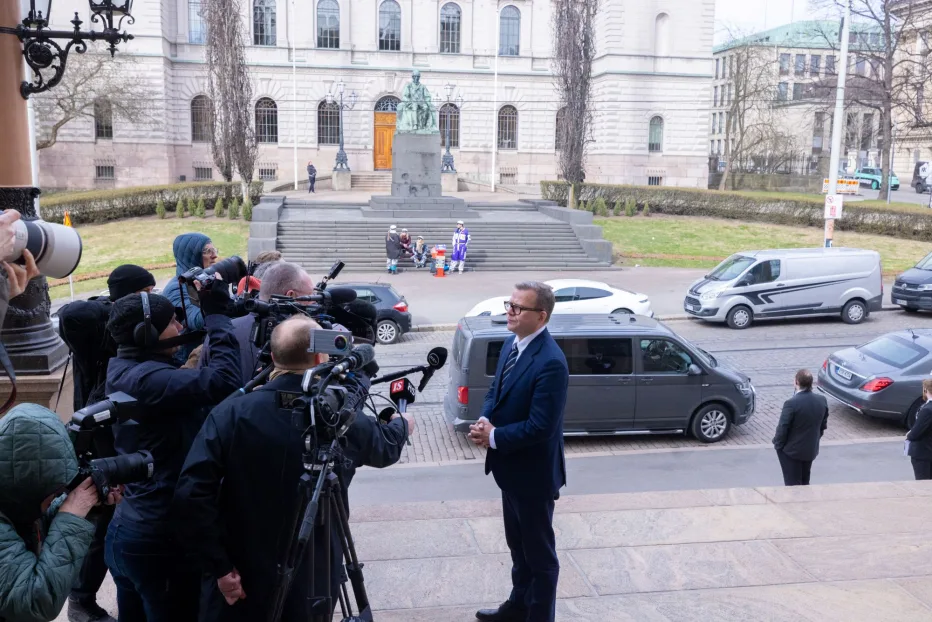
Large number of SY priorities approved in budgetary talks
The Government’s budgetary talks produced decisions on many issues promoted by Suomen Yrittäjät and important to business owners.
Taxes
Mikael Pentikäinen, CEO of Suomen Yrittäjät, the Finnish SME association, considers the tax decisions made in the budgetary talks “quite good”.
“The Government held to its decisions on issues important to business owners: dividend taxation for unlisted companies won’t be raised, the reductions in the highest marginal tax rates will be maintained and the corporate tax cut will take effect at the beginning of 2027.
“Predictability is absolutely essential for companies in tax policy. When a business owner takes risks and invests, there must be a predictable outlook for years ahead.”
Pentikäinen says the promise to reform taxation of employee stock options is also positive, as it will strengthen growth companies’ ability to attract skilled employees. For shares in unlisted companies, the timing of taxation will be moved from the exercise of the employee stock option to the sale of the underlying asset.
In addition, directed personnel share issues will be reformed to allow employees of subsidiaries to receive shares in the group’s parent company.
Household tax credit
The package of measures for construction includes several proposals from Suomen Yrittäjät. The association says an important decision was made in the budgetary talks to improve the household tax credit. This is expected to boost construction, strengthen services provided in the home and support small business ownership across the country.
The household tax credit will be increased for 2026 and 2027. The deductible will remain unchanged, but the maximum amount will be raised to €2,100 and the deductible portion will increase from 35% to 40% for services purchased from companies and from 13% to 15% for wages paid.
“The increase in the household tax credit is a welcome measure that supports consumers’ purchasing power. It is very good that the increase is being made in a sector-neutral way, encouraging households to buy services from companies in all sectors covered by the credit,” says Jukka-Pekka Hellman, Tax Specialist at Suomen Yrittäjät.
“However, the temporary nature of the increase unfortunately means that the parameters of the credit will continue to move back and forth. The deductible should have been put back to €100. From the perspective of the intended benefits and the effectiveness of the credit, the credit rates could have been increased further, and historically they have also been higher on average.”
Business income deduction
The business income deduction will rise from 5% to 5.5%. The deduction was originally introduced at the beginning of 2017 as a result of strong advocacy work by Suomen Yrittäjät.
“The increase in the business income deduction is an excellent measure to improve the conditions for business activity, especially for solo business owners, many of whom operate as sole traders. The Government has already decided to lower the corporate tax rate to 18%, and it is excellent that the Government is now also taking account of business owners operating in other company forms. The increase in the business income deduction is in line with the corporate tax cut in scale,” Hellman says.
Payment terms
Enforcement of payment terms regulation is an important decision for business owners. Suomen Yrittäjät has long kept the issue on the agenda and has also called for the introduction of a supervisory authority.
Large companies in particular shamelessly use smaller companies as their banks and delay payment of invoices by as much as several months.
“Companies claim that long payment terms have been agreed, even though they have been dictated. It’s difficult for a small subcontractor to challenge the terms. Once there is a supervisor for payment terms regulation, those treated unfairly will at least have an authority to report their treatment to. This issue must be taken forward quickly,” says Tiina Toivonen, Legal Affairs Manager at Suomen Yrittäjät.
Deregulation
Suomen Yrittäjät welcomes the continuation of deregulation, and the Government has compiled a broad 50-point list of measures for this purpose.
“Excessive regulation makes entrepreneurship more difficult. It is important to continue deregulation and ease SME financing,” says Päivi Puonti, Vice President and Chief Economist at Suomen Yrittäjät.
Financing
An important decision was made in the budgetary talks to secure growth financing for small companies. Financing legislation will be amended to ensure that the financing system better supports SME growth, investment and competitiveness.
“In practice, the Government can implement the decision by first removing national overregulation that is harmful or unnecessary from the perspective of business financing,” says Petri Malinen, Senior Economist at Suomen Yrittäjät.
“In addition, Finland must work actively and ambitiously to ensure that the ongoing clarification of financial sector regulation in the EU succeeds in creating a better functioning and more manageable regulatory framework, giving the financial sector the tools to support stronger growth in companies and the economy.”
Fuel and energy
The Finnish SME association considers it important that the Government set out its position on professional diesel, which was also included in the Government Programme, but is concerned that it would not enter into force until 2028. The Government decided to introduce professional diesel for at least ten years starting in 2028.
“The decision will help later, but it does not ease the acute distress faced by SMEs. Faster remedies would have been needed,” Puonti says.
A significant number of new transport projects and the possibility of national flexibility in the AdBlue system were also decided. At the same time, however, the Government decided to make permanent cuts to basic transport infrastructure maintenance.
“The cut threatens to further weaken the functioning of the transport system and increase costs for companies in the longer term,” Malinen says.
In agriculture, the energy tax rebate is set to increase. A recent Yrittäjägallup survey shows that 63% of companies in primary production say the Middle East crisis has had a negative impact on their business.
“This will ease the cost crisis that has followed the rise in energy prices,” Puonti says.
Special economic zones
The budgetary talks also produced a decision to prepare a fixed-term trial of special economic zones.
“This is a new industrial policy instrument in Finland, although special economic zones are established operating models in many EU countries. It is now very important to ensure that the support measures are effective enough to achieve the objectives,” says Harri Jaskari, Director of Industrial and Economic Policy at Suomen Yrittäjät.
It is also important to draw on the special economic zones in European countries that have succeeded in achieving their objectives. For example, administrative bureaucracy must be minimized in the zones, as must the speed of permit processes. If the results are good, special economic zones could be introduced across Finland while avoiding distortions of competition within the country.
Youth package
The budgetary talks also included a decision to improve young people’s entrepreneurial capabilities. Suomen Yrittäjät has long proposed increasing entrepreneurship education, and this will now happen.
The Government will increase entrepreneurship education in comprehensive schools, vocational schools and upper secondary schools and promote financial literacy. This will be implemented based on the entrepreneurship education guidelines currently being prepared. Suomen Yrittäjät has worked to secure the guidelines and is also involved in drafting them. The association has also promoted an entrepreneurship diploma for upper secondary schools and the development of entrepreneurship-related qualification modules for vocational schools, which will now be implemented.
“Improving young people’s entrepreneurial capabilities responds to young people’s needs, as more than half of young people are interested in entrepreneurship and one third intend to start a company. We all need financial skills and entrepreneurial capabilities, which are basic skills for the future,” says Mikko Kinnunen, Education Policy Specialist at Suomen Yrittäjät.
The Government will also examine a lighter company model for 15–25-year-olds by further developing the Junior Achievement model. Under the model, company profits would be tax-exempt up to a certain limit, accounting would be automated through systems such as those of the Tax Administration, and the model would be complemented by entrepreneurship and financial skills education in lower secondary school and upper secondary education.
“When the study moves on to practical measures, it will open up entrepreneurship as a genuine opportunity for young people while they’re still at school, as they prepare for employment after graduation and as a way to employ themselves in summer jobs. When young people recognize their abilities, use their skills, solve challenges and create solutions and innovations, they create value both for themselves and for society,” Kinnunen says.
In 2026–2027, the Government will also carry out a €15 million pilot in cities with high youth unemployment to develop new effective ways to reach and support young people in a weak labour market position who are outside work and education. Suomen Yrittäjät has worked to ensure that employment measures make greater use of the private sector. This will happen, as the pilot will make extensive use of both the private and third sectors.
Employment
Suomen Yrittäjät thanks the Government for several measures aimed at promoting employment, especially among people in weaker labour market positions. In addition to the youth employment voucher and targeted pilots for youth unemployment, these measures include a skills voucher for the long-term unemployed and a targeted labour market policy grant for those who are harder to employ.
“It is important that the Government has sought ways specifically to make employment easier for these groups. At the same time, we must remember that the most important way to lower the threshold for hiring and improve employment is to continue structural labour market reforms,” says Atte Rytkönen-Sandberg, a Vice President at Suomen Yrittäjät.
Freedom of choice trial
Katja Rajala, Industrial and Economic Policy Specialist at Suomen Yrittäjät, considers it an excellent decision that the freedom of choice trial for people aged 65 and over will be continued and that common examinations, such as X-ray imaging, will be included.
“The trial will also be extended to physiotherapy visits to improve older people’s everyday functional capacity. This decision supports entrepreneurship and freedom of choice and, above all, improves access to services for the public.”
Are you a Suomen Yrittäjät member yet? Read more about member benefits and advantages!

Mikko Heino
mikko.heino@yrittajat.fi


